
Be Informed for Impactful Decision-Making
We design and carry out studies
The Medcorp Association aims to actively contribute to the development and implementation of a model of preventive and curative medicine that ensures both optimal clinical effectiveness and maximum efficiency of prophylactic services provided to the population, as well as a valuable tool for the implementation of policies addressing major public health problems.
Our programmes and campaigns are based on national and international information and statistics.


Report on the Degree of Development of the Administrative Territorial Units of Prahova County and Their Access to Health Services.
Study commissioned by Prahova County Council financed by OMV Petrom and conducted by Medcorp Association.

State of Health in the EU - Romania - 2021 Country Health Profile
Life expectancy in Romania is among the lowest in Europe, and the COVID-19 pandemic has offset some of the increase since 2000. The pandemic has highlighted the importance of strengthening primary health care, preventive services and public health in a health system that currently depends heavily on hospital services. Health workforce shortages and high patient costs are key barriers to access. The COVID-19 pandemic has spurred the creation of more electronic information systems to better manage overstretched health resources, and these may provide ways to strengthen health systems in the future.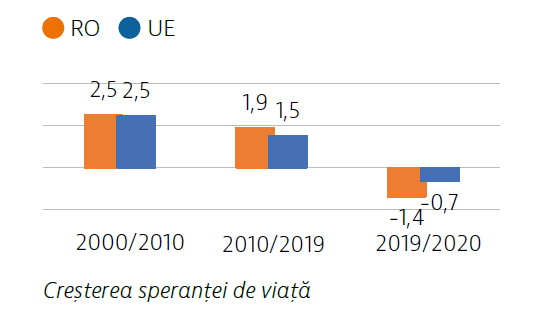
Life expectancy
Life expectancy in Romania increased by more than four years between 2000 and 2019, but temporarily decreased by 1.4 years in 2020 due to the impact of the COVID-19 pandemic. There is a major gender disparity, with women living almost eight years longer than men. Cardiovascular disease is the leading cause of mortality, while lung cancer is the most common cause of cancer deaths.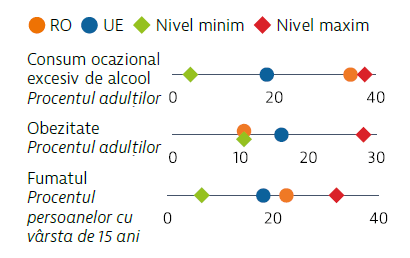
Risk factors
Risky health behaviours contribute to almost half of all deaths. Reported rates of alcohol consumption and unhealthy eating among Romanians are higher than the EU average, but adult obesity is the lowest in the EU. The prevalence of smoking among adults is now slightly lower than the EU average. These risk factors are more common among men than women. Overweight, obesity and smoking among adolescents are high and have increased steadily over the last two decades.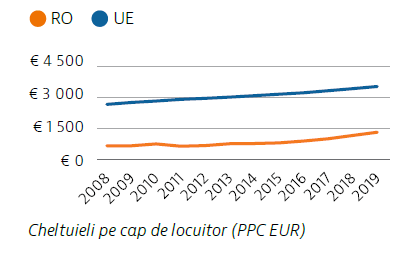
Health system
Spending on health in Romania has increased over the last decade, but remains the second lowest in the EU as a whole - both as a percentage of GDP and as a per capita share. In 2019, around 44% of health expenditure was allocated to hospital services, which is the highest percentage among EU countries. Although the share of public spending on health is high and in line with the EU average, out-of-pocket payments are above the EU average and are dominated by outpatient pharmaceutical costs.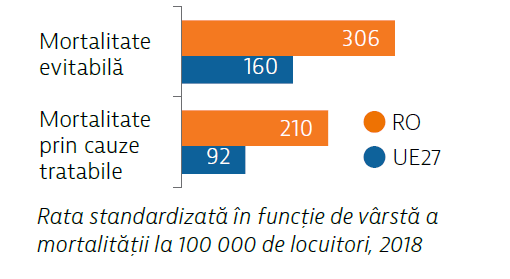
Effectiveness
The avoidable mortality rate is the third highest in the EU, the main causes being cardiovascular diseases, lung cancer and deaths due to alcohol consumption. Mortality from treatable causes is more than twice the EU average and includes deaths from treatable prostate and breast cancer.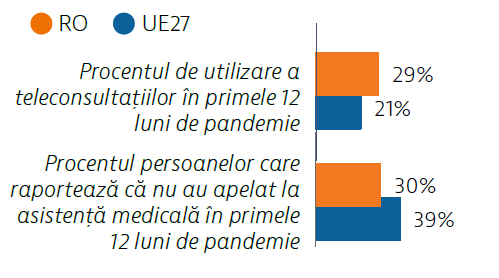
Accessibility
Although the self-reported unmet need for medical examinations in 2019 has more than halved compared to 2011, there has been an increased rate of healthcare dropouts in the first year of the pandemic. Teleconsultations were not used as much as in other EU countries.Disparities in access to health care persist:
More than 70% of people in rural areas say they cannot afford to attend a specialist medical consultation.

Direction 1
Addressing medical problems that citizens from disadvantaged backgrounds already report and providing free medical services by facilitating these services in their proximity for a predetermined period of time.
Direction 2
Preventing health problems that people living in disadvantaged environments might develop, detecting possible health problems they have.